
GST collections jumped 15 per cent to nearly Rs 1.68 lakh crore in November, the finance ministry said on Friday. Goods and Services Tax (GST) mop-up was over Rs 1.45 lakh crore in November 2022.

We need not spend much time going over what this government has done and is doing to the Opposition, by misusing the Enforcement Directorate and the CBI. There is a daily update on that, notes Aakar Patel.

Indians' belief in the country's economic future has diminished in the recent years, with the COVID-19 pandemic taking a further toll on sentiment while pushing many middle-class citizens into poverty, former RBI governor Raghuram Rajan has said. Virtually addressing an event organised by the NALSAR University of Law, Rajan further said the domestic stock market is booming but that does not reflect the reality that many Indians are in deep distress.

Prime Minister Narendra Modi on Tuesday met prominent US personalities from different walks of life, including Tesla CEO Elon Musk who asserted that India has more promise than any other large country and that he is incredibly excited about its future.

Reserve Bank of India's former governor Raghuram Rajan on Wednesday joined Rahul Gandhi during the Congress-led Bharat Jodo Yatra in Rajasthan.

The overall growth rate would see a better performance from agriculture and allied services and the sector is expected to grow by 4 per cent in 2010-11, up from a negative growth of 0.2 per cent in 2009-10. The services sector too is expected to show an improvement in growth in the current financial year to 9.3 per cent, up from 8.1 per cent in 2009-10.

'We should look at is full year's growth rather than quarter numbers.'

It is thanks to the policy of liberalisation conceived by Manmohan Singh and enforced by P V Narasimha that the Indian economy has now become the world's 5th largest economy by nominal GDP, asserts Dr Sudhir Bisht.

India's economic growth will be above 6 per cent in the current fiscal as the country has managed to strengthen its macroeconomic stability and performance even in a period of large global shocks, RBI Monetary Policy Committee (MPC) Member Ashima Goyal said on Monday. Goyal further said that a global slowdown reducing India's export growth, geopolitics fueling oil and food prices, and erratic weather are some of the continuing risks that the country faces. "India has managed to strengthen its macroeconomic stability and performance even in a period of large global shocks.

The wholesale price-based inflation eased for the eighth consecutive month to 4.73 per cent in January on easing prices of manufactured items, fuel and power. The wholesale price-index (WPI) based inflation rate was 4.95 per cent in December 2022 and 13.68 per cent in January 2022. Inflation in food articles, however, rose to 2.38 per cent in January, from (-) 1.25 per cent in December, 2022.

'In India those who want change cannot bring about change, and those who can bring about change do not want change.'

'The sense of Constitutional propriety and political morality seems to be vanishing fast.' 'There are many things in today's politics of governance which Manmohan Singh would have never dreamt of saying or doing.'

JP Morgan's decision last week to include Indian government bonds in its Government Bond Index-Emerging Markets (GBI-EM) index and the index suite from June 2024 may be a sort of blessing for India, as the move is estimated to result in an inflow of $25 billion of foreign portfolio investments into the country. The development comes at a time when the spread between the benchmark 10-year government of India bond and the 10-year US government bond has declined to its lowest level in more than 17 years. Low yield spreads make Indian bonds less attractive to foreign portfolio investors (FPIs).

The judiciary, the police, the lawyers and the public will have to know the new laws. It will also endanger settled jurisprudence on the old laws and open up all sorts of minor and major problems that currently do not exist. Whose then was asking for the change? Not the judges or police or lawyers or citizens, points out Aakar Patel.

'In economic matters governments should not take sides based on religion and caste,' says T C A Srinivasa-Raghavan.

They believe that the key reason behind such a high growth rate could be "a steep downward revision" of the year-ago base period.

Interrupting a two-month streak of decline, outward foreign direct investment (FDI) rose sequentially to $1.85 billion in July over $1.07 billion in June, an increase of 73 per cent. However, it was lower than the $2.18 billion in July last year, according to the Reserve Bank of India data. Outbound FDI, expressed as financial commitment, has three components - equity, loans, and guarantees.

Youngsters must remember education is their BIGGEST investment EVER: Their lifelong income-earning provider! asserts CA P V Subramanyam.

The days of anti-reform, anti-growth advisers that undermined our economy in the UPA-II years will now be strictly behind us: Bhagwati

Sounding a note of caution, former Reserve Bank Governor Raghuram Rajan has said that India is "dangerously close" to the Hindu rate of growth in view of subdued private sector investment, high interest rates and slowing global growth. Rajan said that sequential slowdown in the quarterly growth, as revealed by the latest estimate of national income released by the National Statistical Office (NSO) last month, was worrying. Hindu rate of growth is a term describing low Indian economic growth rates from the 1950s to the 1980s, which averaged around 4 per cent.

The rupee's recent decline is sharp, yes, he says, but the tale would be scary if India was like the Asian crisis countries of 1997-98, or even Argentina in 2001, when large amounts of debt was denominated in foreign currency. According to him, India's percentage of external debt to GDP was around 20
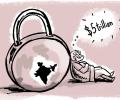
India might be heading towards a "serious livelihood crisis" as the situation seems to be worse this time for the working class amid the COVID crisis and local restrictions by states already add up to something close to a nationwide lockdown, according to noted economist Jean Dreze. In an interview to PTI, he also said the government's target to make India a $5 trillion economy by 2024-25 was never a "feasible target" and was just to pander to the "super-power ambitions" of the Indian elite. About the impact of the second wave of COVID on the Indian economy, the eminent economist said the situation today is not very different from what it was around this time last year as far as working people are concerned.
Despite the narrowing spread of yields between the benchmark 10-year Indian government bond and the 10-year US Treasury bond, foreign portfolio investors (FPIs) are continuing to invest in the domestic debt market this year -- a trend backed by a stable currency and a less volatile bond market. FPIs have been net buyers in the debt market in 2023 so far, marking the first time since 2019. The yield spread between the 10-year Indian government bond and the 10-year US Treasury note stood at 3.14 per cent on August 8 - the narrowest in over a decade.

The hope that the ongoing 13th round of negotiations towards an India-UK free trade agreement (FTA) could conclude with a deal for British Prime Minister Rishi Sunak to sign off in time for the India versus England World Cup cricket clash in Lucknow on October 29 seem to be fading, according to a UK media report on Wednesday. The Financial Times quoted officials briefed on the negotiations to say that a lack of movement towards opening up of the Indian market to British professional services in the field of law and accountancy is among the factors for the slowdown. So much so that cricket fan Sunak's proposed return visit to India after an inaugural visit as UK Prime Minister to New Delhi for the G20 Summit last month is looking "very, very unlikely to happen".

'Our study finds that only about 20% of Indians are vegetarians and the rest of the 80% are non-vegetarians or meat-eaters.'

The Indian economy has recovered 'handsomely' from the pandemic-induced disruptions, former Niti Aayog vice chairman Arvind Panagariya said on Tuesday, while expressing hope that the recovery will be sustained and the growth rate of 7 to 8 per cent will be restored. Panagariya suggested that the government must now signal its intention to wind down fiscal deficit by cutting it by half-to-one percentage point in 2022-23. "The Indian economy has recovered handsomely, returning to its pre-COVID GDP... "Only private consumption is still below its pre-COVID-19 level," the eminent economist told PTI in an interview.

As a percentage contributor to nominal GDP, PFCE's share was 60.1 per cent in FY23, compared with 59.6 per cent and 60.8 per cent in the two preceding fiscal years. "Although PFCE is expected to grow 7.7 per cent in FY23, we believe it is still short of a broad-based recovery. "The current consumption demand is highly skewed in favour of goods and services consumed largely by the households falling in the upper income bracket. "A broad-based consumption recovery, therefore, is still some distance away," said Sunil Kumar Sinha, principal economist with India Ratings.
India's outward Foreign Direct Investment (FDI) nosedived to $11.12 billion in January-June (H1 2023) from $23.57 billion in the same period last year, indicative of the slowdown in the global economy, according to the Reserve Bank of India (RBI) data. The outward FDI expressed as the total financial commitment, has three components, namely equity, loan and guarantees. The sharp contraction in the commitments (outward FDI) was prominent in the April-June 2023 period.

Fitch Ratings on Thursday retained India's growth forecast for the current fiscal at 6.3 per cent citing economic resilience despite tighter monetary policy and exports weakness, but upped year-end inflation projection on El Nino threat. The Indian economy grew 7.8 per cent in the April-June quarter of current fiscal on strong services sector activity and robust demand. "The Indian economy continues to show resilience despite tighter monetary policy and weakness in exports, with growth outpacing other countries in the region," Fitch said, while projecting 6.3 per cent growth for current fiscal (April-March), and 6.5 per cent for next fiscal.

Now that the economy is growing at a higher-than-expected rate, it is time to accelerate the pace of fiscal consolidation, and the Budget could be a good starting point, argues Rajesh Kumar.

Indian economy is expected to clock an average growth rate of 6.7 per cent till 2026-27 fiscal driven by domestic consumption, S&P Global Ratings senior Economist (Asia Pacific) Vishrut Rana said on Wednesday. He said the economic growth in the current fiscal is expected to come in around 6 per cent, lower than 7.2 per cent clocked in 2022-23. "We are seeing some headwinds from the trade side which is affecting activity and that is one of the factors that is affecting growth this year," Rana said at a webinar.

Even if no statistical jugglery is afoot, only to warn that the 'noise' in the numbers should be eliminated in order to hear the underlying music, without distortion, warns T N Ninan.

Get more people working, get more people working in modern manufacturing and services in our cities, and get people working better and longer, suggests Naushad Forbes, past president, CII.

The Indian rupee, which has depreciated 1.1 per cent so far in August, is expected to decline further on the back of a strengthening US dollar and a weakening Chinese yuan, according to a Business Standard poll of analysts. The Indian rupee hit an all-time low recently, closing at 83.15 per dollar. Five of the 10 respondents said the Indian currency might touch 83.5 per dollar in August itself, while others said the worst could be over.

Tharman Shanmugaratnam, an Indian-origin Singapore-born economist, registered a landslide victory in Singapore's presidential election on Friday, winning over 70 per cent of votes in the country's first contested presidential polls since 2011.
Reflecting subdued global economic growth, India's outward foreign direct investment (FDI) fell by 33.3 per cent sequentially to $1.21 billion in August, compared to over $1.82 billion in July.

A piece of slightly negative news can cause a serious setback, warns Debashis Basu.

The Taliban dispensation in Afghanistan has said that India will resume work in at least 20 stalled projects in several provinces across the war-torn country.

Domestic equity markets are in elite company. In May, Indian markets joined select developed markets (DMs) such as the US, UK and Germany to record new all-time highs. Among emerging markets (EMs), Brazil is the other market to have logged new highs this month. Asian peers such as South Korea, Taiwan and New Zealand are currently between 2 per cent and 10 per cent below their previous highs made earlier this year. The domestic markets were among the worst-performing major global markets in April amid a lethal second-wave of covid-19 infections.

'Had they agreed to our demands that we raised two years ago, we would have never started our agitation again.'
